A no-nonsense guide to getting your business discovered in the AI search era.
SEO = Search Engine Optimization (traditional Google search)
AEO = Answer Engine Optimization (AI-powered answers)
GEO = Generative Engine Optimization (AI content synthesis)
Is SEO dead? No. It's evolved. You need all three working together now.

___________________________________________
I hear this all the time: "But I'm a small business and my marketing strategy has been social media."
Great. But social media marketing is a small part of the big picture.
What I always ask my clients: How do you want to show up? What do you want to be known for? What problems are you solving?
SEO, AEO, and GEO answer one fundamental question: How is your content organically discovered by the right audience?
AI isn't replacing search. It's replacing your website as the first place customers engage with your brand.
The good news? Most small businesses haven't figured this out yet. The ones who move now will have a real competitive advantage.
___________________________________________
LLM stands for Large Language Model. These are the systems behind ChatGPT (OpenAI), Claude (Anthropic), Gemini (Google), and Perplexity (hybrid). When people talk about "AI," this is usually what they mean.
AI loves to answer questions. Have you noticed that when you do a Google Search now, you're often getting an AI-generated answer rather than a list of links? That's Google's AI Overview in action, and it appears in nearly 19% of search results.
Here's the shift: Users who see AI Overviews click through to actual websites only 8% of the time, compared to 15% for traditional search results. But 90% of users still click through to cited sources to verify information.
Translation: If AI doesn't cite you, you're invisible. But if it does cite you, that traffic is higher quality than ever.
___________________________________________
Yes. But we've shifted to keyword phrases and question-based queries.
One of my keyword phrases is: digital content strategy for small businesses.
Now we flip it into a question. Think about your end user. What are they likely to search for?
"What's the quickest way for a small business to grow their digital marketing?"
Then you answer.
___________________________________________
1. Get Specific with E-E-A-T
Search Engine Land published an article defining how Google rates search. There's an acronym: E-E-A-T, and it stands for Experience, Expertise, Authority, and Trust.
Before hitting publish, ask yourself: Does my content demonstrate these four things?
Think tailored information specific to your audience. Not broad strokes.
2. Use Loop Marketing (HubSpot's Framework)
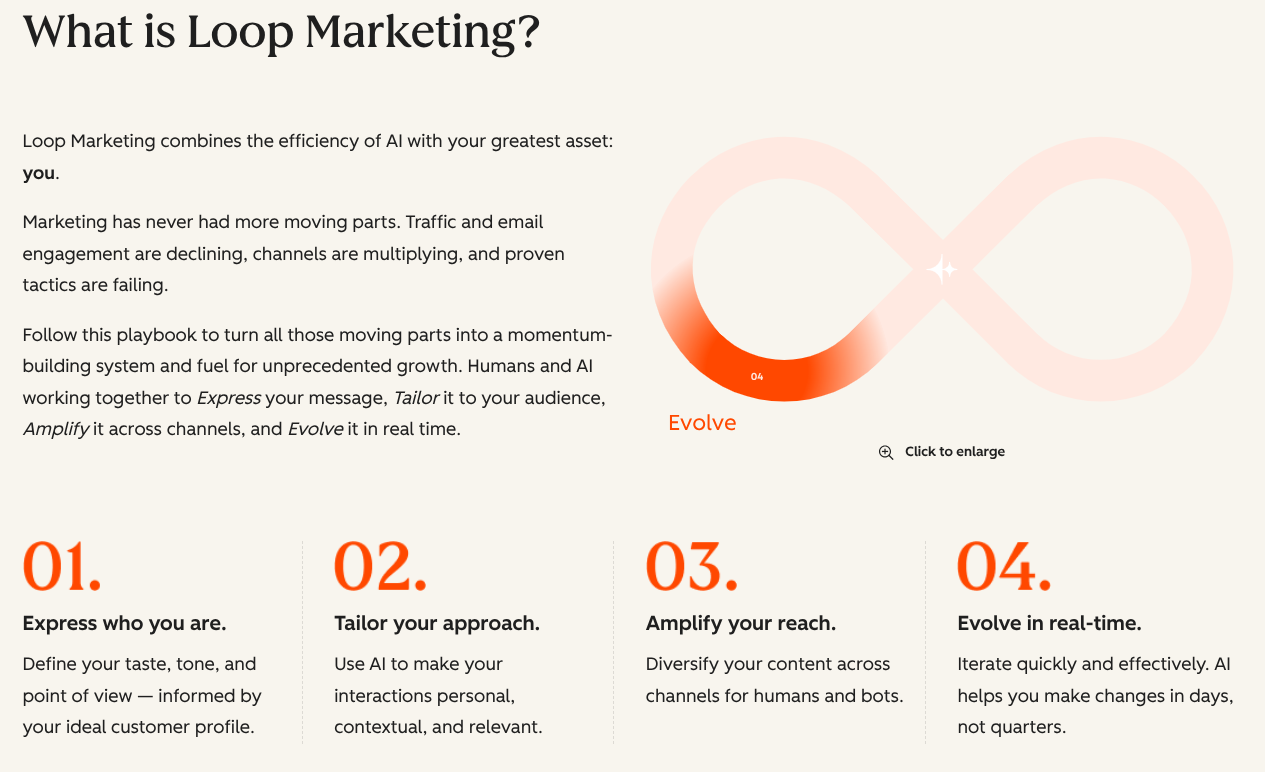
You should be considering Use Case, Persona and Industry:
3. Write Your Content as a Conversation
AI engines favor content that sounds natural and conversational. Write like you're explaining something to a smart friend, not like you're writing a textbook.
4. Make Every Section Stand Alone
You don't know which section an LLM is going to pull. Each section should make complete sense in isolation. Include enough context that a reader (or AI) could understand it without reading what came before.
___________________________________________
Want the full breakdown? Watch this video from HubSpot.
If you don't have time for the full thing, I've distilled it here with my own take on each point.
1. Put the Answer First: Top of your content, don't bury it. AI engines pull from the first section that directly answers the query. A good practice: 40-60 words that directly answer the question, followed by supporting detail.
2. Add Context: Expand on the answer. Show the "why." Go deeper than the obvious. Explain not just what but why it works.
3. Add Structure: Break up content with:
4. Add an FAQ at the Bottom: Quick takeaways. 3-5 questions with 50-60 word answers. These are prime targets for featured snippets and AI citations.
5. Add Original Insights: This list is obviously inspired by the HubSpot video above, but the goal is to spread your own unique experience and expertise throughout. Your voice, your examples, your perspective. That's what makes your content worth citing.
6. Link to Your Product: Make sure every point ties back to what you offer.
Example: Feeling overwhelmed by digital content strategy? Great Life's Work can help you put together the strategy to help your small business show up like a major player without losing your authenticity.
7. Add Schema Markup: Schema helps AI and search engines understand your content. I love Webflow because it analyzes your content and handles the schema markup for you. For more technical details, check out schema.org.
___________________________________________
AI engines love clear, quotable statements in Subject-Verb-Object format. These are called "semantic triples."
Examples:
Each of these statements can stand alone. They're easy to quote. AI engines notice.
___________________________________________
(See what I did there? This FAQ section is exactly what I'm talking about in step 4. These quick-hit answers are prime real estate for AI citations and featured snippets.)
Does it really work? Yes. AI search traffic converts at 4.4x the rate of traditional organic because users arriving from AI citations have already been qualified. AI recommended you.
How long does it take to see results? AEO is evolving fast. Regular, consistent content is the game. It's a long game with fast results. I tell everyone: give me 6 months of consistent effort.
I'm a small business drowning in day-to-day operations. How do I implement this when I don't have capacity? Hire Great Life's Work to work with you. We create the framework and implement it so you can show up as a major player on a small business budget.
What about AI referral traffic? Is it actually significant? Right now, AI referral traffic accounts for about 1% of all website traffic across industries. That sounds small, but it's growing rapidly, and that traffic is significantly higher quality. The brands building citation authority now will have a massive advantage as AI search continues to grow.
Should I focus on AEO or GEO? Both. AEO (featured snippets, AI Overviews, voice search) and GEO (being cited by ChatGPT, Claude, Perplexity) require similar content strategies: clear answers, structured content, and authoritative expertise. The content that wins in one usually wins in both.
___________________________________________
AI hasn't replaced search. It's replaced your website as the first touchpoint.
The brands showing up in AI answers today are shaping the new customer journey. Optimize for both traditional search AND AI citations, and you'll dominate visibility.
Make your content:
Write like a human. Optimize like a strategist. Show up consistently.
That's Great Life's Work.
Ready to make your small business discoverable in the AI era? Book a call and let's build a strategy that actually works.